How to Dispose of Construction Waste in Asheville, NC
Construction projects make a mess. Whether you’re pulling permits for a full gut renovation on a 1940s craftsman in Montford, swapping out flooring in a condo near the South Slope, or running a multi-phase commercial build off Brevard Road, the debris piles up faster than most people expect. Knowing how to dispose of it correctly saves you time, avoids fines, and keeps your job site running without unnecessary stops.
This guide covers every disposal option available in Asheville and Buncombe County, what each one is best suited for, and how to make the right call based on your project type and debris volume.
What Counts as Construction Waste
Construction and demolition waste, called C&D waste in the industry, covers a wide range of materials. Most people think of broken drywall and lumber scraps, but the category is broader than that.
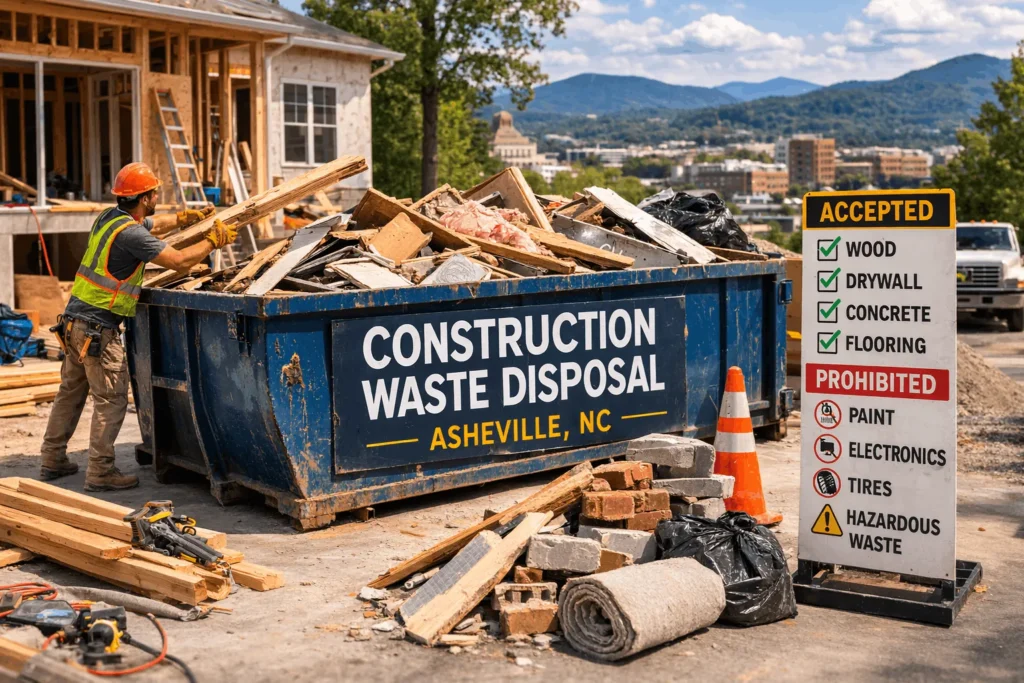
General C&D debris includes concrete, brick, and masonry, wood framing and dimensional lumber, drywall and plasterboard, roofing shingles and underlayment, flooring materials including hardwood, tile, carpet, and vinyl, windows and doors, insulation, metal framing and ductwork, plumbing fixtures and pipe, and general mixed debris from interior demolition.
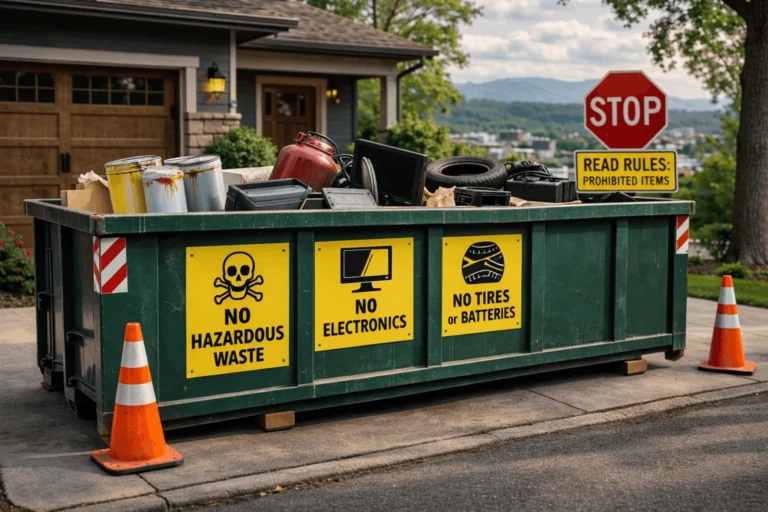
What is not considered standard C&D waste, and therefore cannot go through standard disposal channels, includes asbestos-containing materials from pre-1980 structures, lead paint debris from pre-1978 homes, treated lumber with heavy chemical preservatives, and any hazardous materials mixed into the debris stream. Those categories require separate handling, which this guide covers later.
Asheville’s older housing stock makes this worth paying attention to. A significant portion of the homes in neighborhoods like Kenilworth, Chestnut Hill, Montford, and West Asheville date to the early and mid-twentieth century. If you’re doing any demo work on structures built before 1980, assume asbestos-containing materials may be present until testing says otherwise.
Option 1: Roll-Off Dumpster Rental
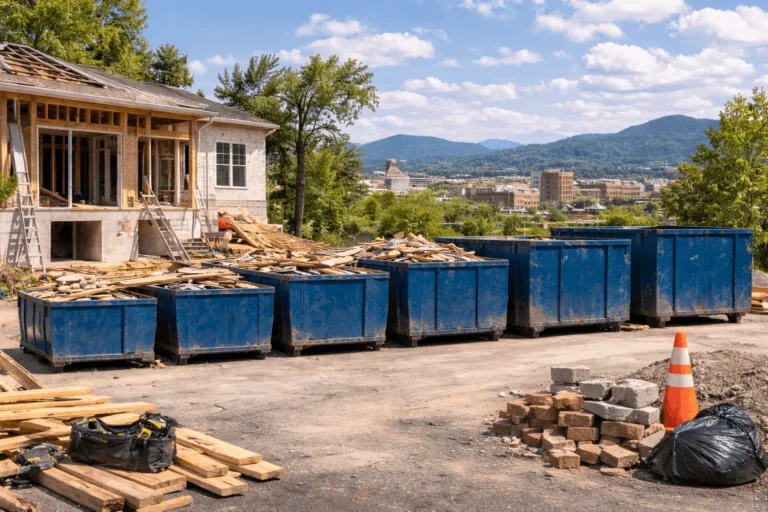
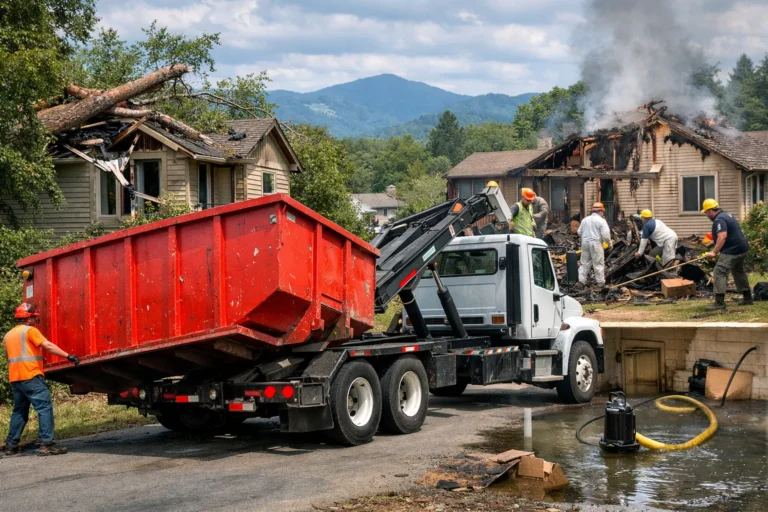
For most construction projects in Asheville, a roll-off dumpster is the most practical disposal solution. It sits on your job site, your crew loads it throughout the project, and it gets hauled when it’s full or when the job wraps up. No separate trips, no hauling debris yourself, no coordinating multiple pickups.
Roll-off containers come in several sizes suited to different project scales. A 10-yard container handles a bathroom renovation or small interior demo. A 20-yard works well for kitchen and bathroom gut jobs, flooring replacements across a full house, or roofing projects on standard residential properties. A 30-yard handles larger full-home renovations, addition builds, and mid-size commercial projects. A 40-yard is suited to large commercial demolitions, multi-unit residential projects, and whole-structure teardowns.
For construction projects specifically, a few things are worth confirming with your rental company before delivery.
Weight limits matter more on construction jobs than on home cleanouts because C&D debris is heavy. Concrete, tile, brick, and roofing material weigh significantly more per cubic foot than general household waste. A 20-yard dumpster loaded primarily with concrete and tile can hit its weight limit long before it looks full. Ask your rental company what the weight allowance is on your container and whether they offer a heavy debris option for projects with significant masonry or concrete.
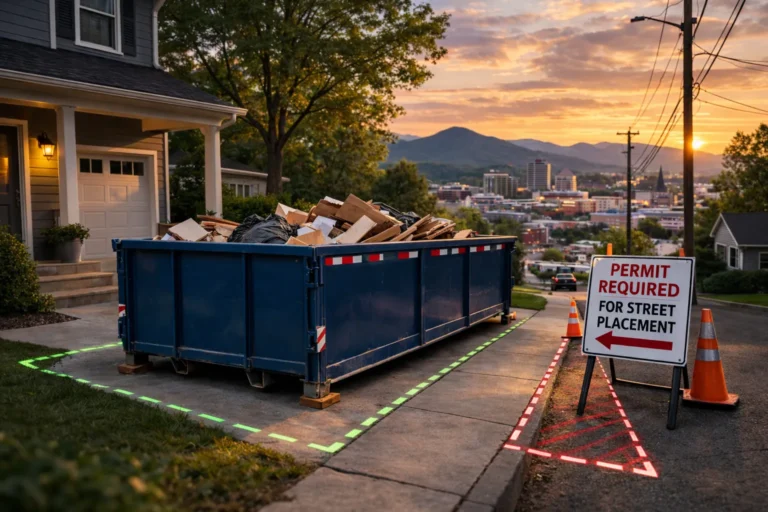
Placement planning also matters more on job sites. If you’re running a renovation project on a busy street near Lexington Avenue or on a tight commercial lot off Merrimon Avenue, think through where the dumpster can go before delivery day. Private property placement requires no permit. Street placement requires a Right-of-Way Encroachment Permit from the City of Asheville at 161 S. Charlotte Street before the container arrives. For large commercial sites, coordinate placement so the container doesn’t block material delivery or equipment access.
Swap-out scheduling is something most residential clients don’t think about but most contractors do. On longer projects, you may need the container hauled and replaced mid-job. Set that expectation with your rental company at booking so there’s no wait when your first container fills up.
Quick question: Can I mix different types of construction debris in one dumpster?
Yes, in most cases. Mixed C&D loads are accepted at licensed facilities in Buncombe County. The exception is if your load contains regulated materials like asbestos or if you’re mixing very heavy materials like concrete with lighter debris, which can create weight issues. For large projects with significant concrete or masonry, a separate dedicated container for heavy debris is worth considering.
Option 2: Buncombe County C&D Landfill and Transfer Station
For contractors and property owners who want to haul debris themselves rather than rent a container, Buncombe County operates solid waste facilities that accept construction and demolition material directly.
The Buncombe County Solid Waste facility operates near the Woodfin area off Hominy Creek Road. This facility accepts mixed C&D debris, clean wood waste, metal, and other materials from construction projects. Tipping fees apply by weight, and you’ll need to know what you’re bringing in because different materials are directed to different areas on-site.
Self-haul works well for smaller projects, single-trade contractors cleaning up after a job, or situations where you’re generating debris gradually and want to make periodic trips rather than renting a container. It requires a truck or trailer with appropriate capacity, and you’ll need to factor in drive time and tipping fees versus the convenience cost of a dumpster rental.
For large volume projects, self-haul rarely makes financial sense compared to a dumpster rental. By the time you factor in fuel, labor time, truck wear, and tipping fees across multiple trips, a roll-off rental usually comes out ahead on most mid-to-large renovation jobs in Asheville.
Call Buncombe County Solid Waste Management at (828) 250-5463 before your first trip to confirm current hours, accepted materials, and tipping fee rates. Hours and accepted material categories do change periodically.
Option 3: Material Separation and Recycling
Not everything coming out of a construction job has to go to a landfill. A significant portion of C&D debris can be recycled or diverted, and in some cases you can recoup value from materials rather than paying to dispose of them.
Metal recycling. Steel framing, copper pipe and wire, aluminum ductwork, and other metals have real scrap value. Several metal recycling facilities operate in the greater Asheville area. Instead of filling dumpster space with metal, pull it out separately and take it to a scrap yard. You’ll free up container space and potentially offset some of your project cost.
Clean wood waste. Untreated dimensional lumber, plywood, and wood framing can be diverted from the general C&D stream. Some facilities accept clean wood separately at reduced tipping fees or for processing into mulch. If you’re doing significant framing demo, ask the Buncombe County facility whether they have a separate wood waste area. Treated lumber with chemical preservatives, including older pressure-treated wood, does not qualify for this stream.
Concrete and masonry. Broken concrete, brick, and block can be recycled into aggregate for road base and fill applications. Several contractors and facilities in western North Carolina accept clean concrete for crushing. If your project involves significant slab demolition or masonry removal, separating concrete into its own pile and routing it to a concrete recycler keeps that weight out of your roll-off and reduces your overall disposal cost. Ask your dumpster rental company or call Buncombe County Solid Waste to find out which facilities currently accept concrete for recycling in the area.
Salvageable building materials. Asheville has a strong market for reclaimed building materials, which makes sense given the city’s creative economy and its large population of remodelers, renovators, and custom builders. Before you throw it in the dumpster, consider whether any of it has resale or donation value.
Habitat for Humanity ReStore on Swannanoa River Road accepts usable building materials including doors, windows, cabinets, hardware, plumbing fixtures, tile, hardwood flooring, and light fixtures. They pick up large donations from job sites in some cases. Dropping off materials you would otherwise pay to dispose of, and getting a tax receipt for the donation, is a straightforward way to reduce both your disposal cost and your project’s landfill impact.
The ReUse Warehouse and several salvage dealers in the River Arts District and West Asheville also buy and sell reclaimed materials. If you’re pulling out old-growth hardwood flooring, vintage fixtures, solid wood cabinetry, or architectural elements from an older home, there is a buyer for that material in this market. It takes a few extra minutes to separate and set aside, but the alternative is paying to throw away something someone else will pay for.
Option 4: Junk Removal Services
For smaller construction cleanups, final site sweeps, or situations where you need debris removed quickly without committing to a multi-day dumpster rental, a junk removal service is worth considering.
Junk removal companies send a crew and a truck, load the material themselves, and haul it away in a single visit. You pay by volume rather than by rental period. This works well for post-renovation cleanups where most of the debris is already consolidated, for single-room demos, or for job sites that don’t have enough debris volume to justify a full roll-off rental.
The limitation is cost per volume at scale. For larger construction projects generating significant debris over several days or weeks, junk removal becomes expensive compared to a roll-off. It also requires the crew to access the site and load the material, which adds a coordination variable that a dumpster sitting on-site doesn’t have.
Handling Regulated Materials in Construction Debris
This deserves its own section because it’s where contractors and property owners in Asheville most commonly run into serious problems.
Asbestos-containing materials. Asheville’s housing stock skews old. The neighborhoods that make the city architecturally interesting, Montford with its Victorian and Craftsman homes, the older bungalows along Merrimon Avenue, the mid-century properties in Kenilworth and Haw Creek, are also the neighborhoods most likely to contain asbestos in floor tiles, pipe insulation, popcorn ceilings, exterior transite siding, roofing felt, and joint compound.
The North Carolina Division of Air Quality requires that any structure undergoing renovation or demolition be inspected for asbestos before work begins if the project disturbs more than a threshold amount of regulated material. For most commercial projects and larger residential projects, this is not optional. A licensed asbestos inspector surveys the structure, samples suspect materials, and issues a report. If asbestos-containing materials are found, a licensed abatement contractor must remove them before general demo begins.
Asbestos waste goes to a permitted disposal facility, not a standard roll-off. Mixing asbestos debris into general C&D waste is a serious violation of federal and state environmental law. If you’re managing a project on any pre-1980 structure in Asheville, build asbestos inspection into your pre-construction timeline and budget. It is far less expensive to handle correctly upfront than to deal with a stop-work order or a cleanup liability after the fact.
Lead paint debris. Homes built before 1978 may contain lead-based paint. Under the EPA’s Renovation, Repair, and Painting Rule, contractors working on pre-1978 residential properties must be RRP certified and follow specific containment and cleanup protocols. Sanding, cutting, or demolishing surfaces with lead paint generates dust and debris with specific disposal requirements. If you’re a contractor in Asheville working on older residential properties and you’re not already RRP certified, that certification is worth getting. The liability exposure without it is real.
Pressure-treated lumber with older preservatives. Lumber treated with chromated copper arsenate, common in older decks, fences, and outdoor structures built before 2004, cannot go into standard C&D disposal streams in most cases. If you’re demolishing an older deck in a backyard in West Asheville or pulling out old fence posts in a residential yard in Arden, set that treated wood aside and ask the Buncombe County Solid Waste facility how they want to handle it before you load it in a container.
Disposing of Construction Waste for Specific Project Types
Different projects generate different debris mixes. Here’s how disposal planning maps to common project types in Asheville.
Roofing replacement. Roofing shingles are accepted in standard roll-off dumpsters. They’re also heavy, so weight limits matter on large roofing jobs. A 10-yard or 15-yard container dedicated to roofing debris works well on most standard residential roofs. Some roofing contractors separate shingles for asphalt recycling, which is available through select facilities. Ask your contractor or rental company whether this option is currently accessible in western North Carolina.
Kitchen and bathroom renovation. These generate mixed light debris including drywall, tile, cabinets, fixtures, and flooring. A 10-yard or 15-yard container handles most single-room renovations. Separate any metal fixtures, copper pipe, and salvageable cabinets before loading to reduce disposal cost and potentially recover some value.
Full home renovation or gut rehab. This is where disposal planning matters most. Large mixed loads require a 20-yard or 30-yard container at minimum. For pre-1980 structures anywhere in Asheville, asbestos inspection must come before demo. Separate metals, salvageable materials, and heavy debris from general waste as you go. Build dumpster swap-outs into your project schedule for jobs running several weeks.
New construction. New builds generate substantial waste including concrete formwork, lumber scraps, drywall offcuts, and packaging. Many general contractors on new builds in Buncombe County manage this with a dedicated on-site container that gets swapped out at project milestones. Coordinating with the waste hauler and scheduling pickups around framing, drywall, and finish phases keeps the site manageable and avoids scrambling at the end of the job.
Commercial demolition. Large commercial demo projects in Asheville typically require a formal waste management plan, particularly if the structure is above a certain size threshold. The NC Division of Air Quality requires notification for demolition projects that disturb regulated asbestos, and OSHA requirements around hazardous materials apply to commercial jobs. Work with a licensed demolition contractor and a waste hauler familiar with the regulatory requirements for commercial C&D projects in Buncombe County.
What It Costs to Dispose of Construction Waste in Asheville
Disposal costs vary based on volume, material type, and the method you choose.
Roll-off dumpster rentals in Asheville typically run from around $300 to $600 for a standard 10-yard container up to $500 to $900 or more for a 30-yard, depending on rental period, weight, and materials. These are general ranges and actual pricing varies between companies. Always ask for an all-in quote that includes delivery, pickup, tipping fees, and what the overage charge is per ton if you exceed the weight limit.
Self-haul tipping fees at Buncombe County facilities are based on weight. Call ahead to get current rates because they adjust periodically.
Junk removal services in Asheville generally price by truck volume, with a single truckload of construction debris typically running $300 to $500 depending on the company and the material.
Asbestos abatement costs vary significantly based on the amount of material, the type of material, and site access. For residential projects, abatement on a small amount of floor tile or pipe insulation may run a few hundred dollars. Full abatement on a larger structure can run into the thousands. Get multiple quotes from licensed contractors and factor this into your project budget before demo begins.
Frequently Asked Questions
Can I put roofing shingles in a dumpster rental in Asheville? Yes. Asphalt shingles are accepted in standard roll-off containers. Because shingles are heavy, watch your weight limit on large roofing jobs and ask your rental company about their overage fee structure before you book.
Can I dispose of concrete in a roll-off dumpster? Most rental companies accept concrete, but it counts heavily toward your weight limit. For significant amounts of concrete, ask about a dedicated heavy debris container or explore concrete recycling options in the area to keep costs down.
How do I know if my Asheville home has asbestos before I renovate? Hire a licensed asbestos inspector to survey and sample the structure before demo begins. This is required by NC Division of Air Quality for projects disturbing above threshold amounts of regulated material in pre-1980 structures. Do not rely on visual inspection alone. Many asbestos-containing materials look identical to non-hazardous versions.
Can I burn construction debris on my property in Buncombe County? Open burning of construction and demolition debris is banned in Buncombe County under both county ordinance and NC Division of Air Quality regulations. This includes lumber, painted wood, treated wood, and composite materials. Do not burn C&D debris regardless of where your property is located within the county.
What is the cheapest way to dispose of construction waste in Asheville? For large volumes, a roll-off dumpster rental typically offers the best cost per cubic yard when you factor in labor, time, and tipping fees. For small volumes, self-haul to the Buncombe County facility on Hominy Creek Road is often the most economical. Donating salvageable materials to Habitat ReStore before disposal reduces your overall volume and therefore your disposal cost regardless of which method you use.
Do I need a permit for a dumpster on my job site in Asheville? Not if the container sits on private property. If it needs to go on a public street or sidewalk, you need a Right-of-Way Encroachment Permit from the City of Asheville’s Permit Application Center at 161 S. Charlotte Street before delivery.
How long can I keep a roll-off dumpster on my job site? Standard rental periods in Asheville typically run 7 to 14 days. Extensions are usually available for a daily or weekly fee. For longer construction projects, many contractors schedule recurring swap-outs rather than extending a single rental indefinitely.
What happens to the construction waste after pickup? Your load goes to a licensed transfer station or C&D landfill in Buncombe County or the surrounding region. Depending on your material mix, some components may be sorted for recycling. Mixed loads that include prohibited materials can be rejected at the facility, which results in additional fees passed back to the customer.
Plan Your Disposal Before Demo Day
The contractors in Asheville who run the cleanest job sites and avoid the most expensive surprises do one thing consistently: they plan debris disposal before the first tool touches the structure. That means knowing what’s in the walls before you open them, knowing your volume and weight before you order a container, and knowing which materials need to be separated and routed differently before your crew starts loading.
Whether you’re a homeowner tackling a first renovation in West Asheville or a general contractor running projects across Buncombe County, the disposal planning conversation is worth having early. It affects your timeline, your budget, and in some cases your legal exposure.
We work with contractors and property owners across Asheville, Weaverville, Black Mountain, Arden, Candler, and the surrounding area. We know the job sites, the access points, and the debris types that come with working in this market. When you call to book, tell us about your project and we’ll make sure you have the right container, the right weight allowance, and the right pickup schedule for what you’re doing.
Get a free quote today. Same-day and next-day delivery available across Asheville and Buncombe County.